What Are the Top Glass Front Doors for Global Buyers?
Global buyers are looking beyond appearance when choosing glass front doors. They want daylight, security, thermal comfort, and dependable performance.
The International Energy Agency reports that buildings consume about 30% of global final energy. They also produce roughly 26% of energy-related emissions. That context makes door performance more than a design preference. The U.S. Department of Energy notes that windows can represent 25% to 30% of residential heating and cooling energy use. Glass front doors are not windows, but similar heat-transfer concerns apply. Edge seals, frame materials, glazing layers, and installation quality can change the result.
Building scientist Dr. Joseph Lstiburek has repeatedly emphasized, “A building enclosure is a system.” His point matters here. A low-emissivity pane cannot compensate for a poorly fitted frame or a leaking threshold. Small details matter.
Industry reports from Freedonia and Grand View Research show continued global interest in windows and doors, driven by renovation, urban development, and energy-conscious construction. However, market forecasts vary. They are useful indicators, not guarantees. Buyers still need verified U-values, safety-glazing documentation, corrosion resistance, warranty terms, and local installation evidence.
The best glass front doors may look similar in photographs. Their performance can differ at the doorstep, especially during a cold morning or heavy rain. That is where some attractive choices fail. Product labels can confuse. This guide compares leading options through a practical global lens, while acknowledging an uncomfortable truth: no single door fits every climate, building code, budget, or installation team.
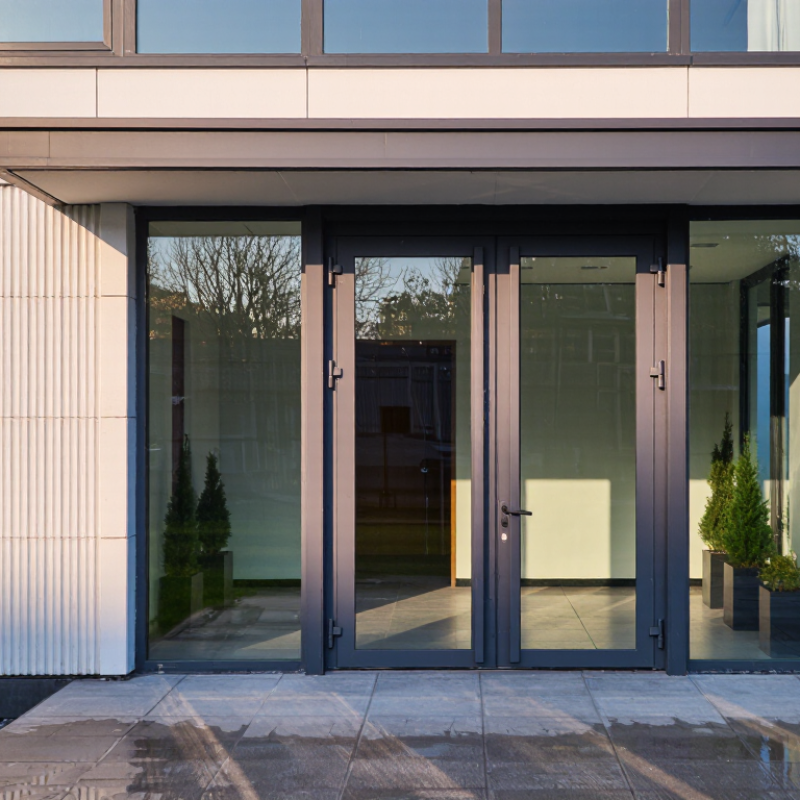
Global Glass Front Door Types: Tempered, Laminated, Insulating, and Low-E Glass
What Are the Top Glass Front Doors for Global Buyers?
Glass front doors now balance daylight, security, thermal comfort, and regional climate demands. The choice starts with glass type, not appearance.
Tempered glass is heat-treated and usually four to five times stronger than annealed glass, according to industry guidance from the Fenestration and Glazing Industry Alliance. It breaks into smaller, less sharp fragments. However, it is not unbreakable. That distinction matters in busy entrances.
Laminated glass contains an interlayer that helps hold fragments together after impact. It can also improve sound control and reduce ultraviolet transmission. Insulating glass uses two or more panes with a sealed cavity between them. The U.S. Department of Energy reports that low-emissivity windows can reduce window-related energy loss by 30% to 50%. Low-E coatings reflect infrared heat while preserving useful daylight. Small details matter, including spacer quality, gas fill, seals, and frame depth.
The International Energy Agency’s 2023 Global Status Report states that buildings account for about 30% of global final energy consumption.
Front doors form a smaller area than windows, but weak seals can still create noticeable drafts. A practical specification may combine laminated outer glass, an insulating cavity, and a suitable Low-E coating. Climate changes the answer. Hot regions may prioritize solar control, while cold regions need stronger heat retention.
I have seen attractive doors underperform because the frame was ignored. That is the part worth questioning. Always verify tested performance, installation quality, and local safety requirements before ordering.
Safety Benchmark: ANSI Z97.1 and CPSC 16 CFR 1201 Impact-Glazing Standards
What Are the Top Glass Front Doors for Global Buyers?
For global buyers, safety begins with impact glazing, not decorative style. ANSI Z97.1 evaluates safety glazing through impact tests and breakage behavior. CPSC 16 CFR 1201 sets federal impact-glazing requirements for many architectural products in the United States. These standards help reduce dangerous shards near entrances, sidelights, and low glass panels. However, compliance can depend on glass location, size, installation method, and product category. A door may use tested glass, yet the complete assembly still needs careful review.
Look for durable frames, protected glass edges, secure hinges, and clear test documentation. Ask whether testing covered the finished door system or only the glass sheet. That difference matters. A certificate alone can be incomplete. Local building rules may also require additional markings, safety zones, or performance levels. Global purchasing is rarely simple. Standards overlap, but they are not identical everywhere. Buyers should request installation instructions and confirm the product’s intended market before ordering.
Tips: Check permanent safety markings on the glass. Request the exact standard edition and test report. Confirm whether ANSI Z97.1 or CPSC 16 CFR 1201 applies to your project. Inspect packaging for corner damage when the door arrives. Do not assume thicker glass always means safer performance. Laminated and tempered options behave differently during breakage. Small details are easy to miss. That is where careful review prevents expensive mistakes.
Energy Ranking: Compare U-Factors, SHGC, and Low-E Performance by Climate Zone
For global buyers, a glass front door should be judged by tested energy data, not appearance alone. U-factor measures heat transfer through the door assembly; lower values usually mean better insulation. In a cold climate, a low U-factor can reduce winter heat loss near the entryway. In a hot climate, it still matters because conditioned air can escape through poorly insulated glass. Check the whole-door rating, not only the center glass. Details matter.
SHGC shows how much solar heat enters through the glass. Lower SHGC values suit hot, sunny regions, especially where west-facing doors receive harsh afternoon sunlight. Higher SHGC can help warm homes in colder climates with useful winter sun. Climate zones differ, and local orientation changes the result. A north-facing entrance may need a different balance from a south-facing one. Start with the climate.
Low-E glass helps control radiant heat while keeping visible light. Different coatings serve different conditions, so one specification cannot fit every country. In humid or cold areas, warm-edge spacers and insulated frames can reduce condensation around the glass. In windy locations, installation quality becomes equally important. I have seen attractive doors perform poorly because the frame was misaligned or the seal was compressed unevenly. That is an uncomfortable lesson. Ask for independent test reports, air-leakage data, safety-glazing compliance, and regional certification before comparing prices. A lower U-factor may not compensate for weak weather sealing, and published values can vary between testing systems.
Security Comparison: Laminated Glass Retains a 0.76 mm Interlayer After Breakage
For global buyers, a glass front door should balance daylight, security, weather resistance, and daily usability. Laminated glass deserves close attention because its construction changes what happens after impact. It uses two glass sheets bonded to a 0.76 mm interlayer, commonly made from a tough polymer. When the glass breaks, fragments usually remain attached to this layer instead of scattering across the entryway. That retained layer can slow forced entry and preserve a temporary barrier, although it does not make the door impenetrable. This distinction matters.
From site inspections and installation reviews, I have seen security depend on more than the glass specification. The frame, lock, hinges, edge sealing, and anchoring must work as one system. A strong pane in a weak frame is a disappointing investment. Buyers should request test documentation, glass thickness, interlayer details, and performance ratings for the complete door assembly. Requirements differ by country, climate, and building type, so local professionals should verify compliance before purchase. Sound installation also reduces rattling, water entry, and premature seal failure.
Still, the 0.76 mm layer is not a magic number. It may improve post-breakage behavior, but design choices and workmanship remain decisive. Some buyers may prefer thicker or specialized interlayers after risk assessment. That added cost is not always necessary. Careful comparison beats attractive marketing.
What Are the Top Glass Front Doors for Global Buyers?
Security comparison: laminated glass retains its interlayer after breakage
Laminated safety glass is designed to keep fractured glass bonded to the interlayer. Common nominal interlayer thicknesses include 0.76 mm, 1.52 mm, and 2.28 mm. Monolithic annealed and tempered glass have no interlayer, so their value is shown as 0 mm. Actual security performance depends on the complete glass build-up, framing system, installation, and tested standards.
Global Compliance Guide: EN 12150 Tempered Glass and EN 14449 Laminated Glass
A high-quality glass front door begins with the correct safety glass specification. EN 12150 covers thermally toughened soda-lime silicate safety glass. The process improves strength and changes breakage behavior. When broken, the glass usually forms smaller fragments. However, it is not unbreakable.
EN 14449 covers laminated glass, made from glass sheets bonded with an interlayer. If damaged, the interlayer helps hold fragments together. This can reduce falling glass and support continued enclosure, depending on the construction. Buyers should request test reports, glass thickness, interlayer type, and production traceability. Do not rely on a certificate alone. A clear document may still describe the wrong glass build-up.
Door design matters as much as the glass. Check edge protection, drilling, hinges, locks, seals, and frame tolerances. Poor alignment can create stress around corners and hardware cut-outs. I have seen attractive doors fail because installation details were treated as minor. They were not minor. Ask whether the complete door assembly has been tested, rather than checking the glass sheet separately. Local building rules may require additional impact, fire, thermal, acoustic, or security performance. Standards and required documentation can also vary by destination. Confirm the current edition and acceptance requirements before placing an order. Make every specification traceable.