10 Tips for Buying Quality Doors from Global Suppliers
Buying quality doors from global suppliers is not a simple price comparison. A door must protect interiors, control air movement, support security, and survive repeated use. Small gaps matter. The U.S. Department of Energy explains that weatherstripping and proper installation help reduce unwanted air leakage around exterior doors. This makes frame accuracy, seals, hinges, and installation guidance important purchasing criteria, not minor details.
Market research also shows why supplier evaluation deserves more attention. Grand View Research’s Doors Market Size, Share & Trends Analysis reports continued growth in global door demand, supported by construction, renovation, and energy-efficiency projects. However, market growth does not guarantee consistent manufacturing quality. A polished product photograph can hide weak core materials, uneven coatings, or unclear test results. That is not enough. Buyers should request measurable specifications, production samples, inspection records, and warranty terms before approving large orders.
This guide presents 10 practical tips for selecting quality doors from international suppliers. It considers material grades, moisture resistance, fire performance, acoustic ratings, hardware compatibility, packaging, and delivery control. Relevant standards may include ISO 9001 quality systems, ASTM testing methods, EN requirements, or local building codes, depending on the destination market. Still, certifications require careful verification. A certificate without a traceable scope may create false confidence. Buyers should compare test laboratories, product models, and manufacturing dates. The best decision balances cost, performance, compliance, and long-term maintenance. Mistakes can happen, even with experienced purchasing teams. Careful documentation reduces them.
Define Quality Standards for Doors Before Comparing Suppliers
Before comparing global door suppliers, define quality in measurable terms. A door is not truly high quality because its surface looks smooth. Specify dimensions, core density, hinge load, air leakage, water resistance, fire rating, acoustic performance, and finish durability. For exterior doors, require test methods and acceptance limits, not vague claims such as “premium grade.” EN 14351-1 and ISO 10140 can guide performance testing for external doors and sound insulation.
The building envelope deserves careful attention. The 2023 Global Status Report for Buildings and Construction states that buildings use about 30% of global energy demand and produce roughly 26% of energy-related emissions. Doors are only one component, but poor seals, warped leaves, and weak frames can increase drafts and maintenance needs. Ask suppliers for laboratory reports, batch records, material declarations, and installation instructions. Check whether test results match the proposed size and configuration.
Small details reveal manufacturing discipline. Request corner samples, hinge-side reinforcement details, gasket cross-sections, and finish samples under natural light. Confirm allowable dimensional tolerance before production. A supplier may pass a test with one model, then change the core or hardware without clear notice. That risk needs written control. Factory audits help, but they are not perfect. I would also inspect packed units for edge protection, moisture damage, and label accuracy. Quality begins before the container leaves the port.
Verify Supplier Credentials, Certifications, and Production Capabilities
When buying doors from global suppliers, a polished website proves little. Request the company’s legal name, factory address, registration documents, and recent production photos. Verify phone numbers, domain details, and shipping information independently. I once trusted a copied certificate, and the delay was expensive. That mistake changed my checklist. A reliable supplier answers specific questions about timber moisture, steel thickness, coating systems, hardware, tolerances, and testing.
Tip: Check certificates with issuing bodies, not screenshots. Confirm the certificate’s scope, product model, factory location, and expiration date. Ask for batch numbers, test dates, and applicable standards. Certifications may cover one model, not every door. This detail is easy to miss. Request physical samples when possible. Compare frame joints, surface finish, seals, glass markings, and packaging labels against the approved specifications.
Tip: Audit production capability before placing a large order. Ask for monthly capacity, machinery lists, quality-control checkpoints, trained inspectors, and corrective-action records. A video call can show cutting, assembly, glazing, and packing areas. However, staged footage remains possible. Arrange an independent factory inspection or pre-shipment inspection. Ask for approved drawings, inspection reports, and traceable batch records. Promises are not proof. Keep every requirement in writing, including tolerances, testing, replacement terms, and delivery conditions.
10 Tips for Buying Quality Doors from Global Suppliers
Use this verification checklist to compare global door suppliers. Prioritize legal credentials, relevant certifications, production capacity, quality controls, material traceability, testing records, export experience, references, warranty terms, and after-sales support before placing an order.
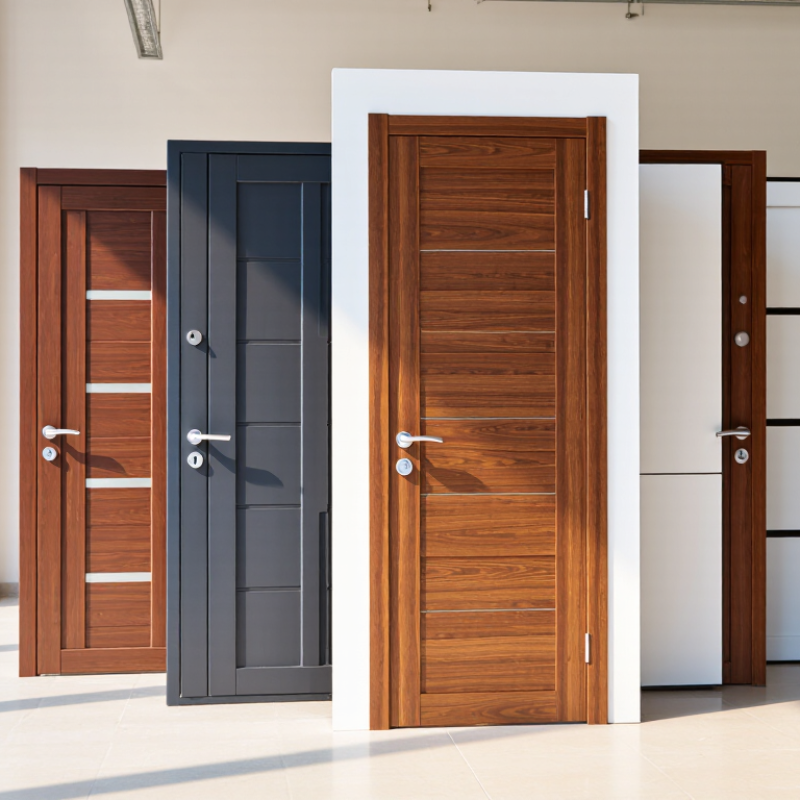
Evaluate Door Materials, Construction, Hardware, and Performance
When buying doors from global suppliers, start with the material, not the finish.
Solid timber offers warmth and repairability, but moisture can cause swelling. Steel provides strength, while fiberglass usually resists corrosion and dimensional change better. Ask for core density, surface thickness, and moisture-testing records. A glossy sample proves little.
Construction details reveal quality. Inspect corner joints, welds, edge sealing, and the meeting point between the slab and frame. Poor alignment creates visible light and costly air leakage.
The U.S. Department of Energy reports that windows, skylights, and doors can represent 25–30% of residential heating and cooling energy use.
Request NFRC-rated U-factor and solar heat gain coefficient data where applicable. Lower U-factor generally indicates better insulation. Check the tested size, not only the advertised value.
Hardware deserves equal attention. Hinges should match the door’s weight, and locks should operate smoothly after repeated cycles. Ask for corrosion testing, cycle-test results, gasket specifications, and replacement availability in your market.
ASHRAE guidance links envelope performance with air leakage, surface temperatures, and moisture control. A supplier who shares test methods is easier to trust.
I once focused too heavily on a beautiful veneer and overlooked weak hinge screws. That mistake became expensive.
Performance labels can also be incomplete. Confirm installation tolerances, certification scope, warranty exclusions, and packaging protection before approving a shipment. Small details matter.
Compare Quotations, Minimum Orders, Lead Times, and Shipping Terms
10 Tips for Buying Quality Doors from Global Suppliers
When comparing door quotations, check the same specifications line by line. Include material, thickness, core type, finish, hardware, packaging, and testing documents. A cheaper price may exclude hinges, frames, or export packing. Ask for a complete cost sheet. Request production photos or a sample before placing a large order. Real details matter.
Minimum order quantities can change the whole calculation. Compare the supplier’s minimum with your storage space and sales forecast. A low unit price is not useful if you must buy 500 doors and store them for months. Ask whether mixed sizes or finishes are allowed. I once accepted a lower quotation without checking this point. The inventory became difficult to manage.
Lead time should include drawing approval, sampling, production, inspection, and loading. Put each stage in writing. Add a small buffer for holidays or port congestion. Shipping terms also need careful comparison. Confirm the named delivery location, freight responsibility, insurance, customs clearance, and unloading costs. Use one currency and one delivery basis when comparing offers. Ask for carton dimensions and gross weight, since warehouse and transport fees can surprise you. Keep all revisions attached to the purchase order. Small omissions become expensive. A final pre-shipment inspection is wise, although it cannot replace reliable supplier communication.
Inspect Samples and Confirm Quality Control Before Placing an Order
Buying doors from global suppliers requires more than comparing prices. I learned this after receiving samples that looked excellent in photos but felt weak in person. Request a full-size or production-grade sample before placing a large order. Check the frame joints, hinge alignment, surface finish, edge sealing, and hardware movement. Open and close the door repeatedly. Listen for rubbing or looseness. Small faults often reveal rushed assembly.
Ask the supplier to explain its quality control process in clear, measurable terms. Confirm moisture testing, dimensional tolerances, coating inspection, and load checks. Request inspection records from recent production, not only a prepared company statement. Photos should show labels, measuring tools, and actual factory conditions. A live video inspection can also expose inconsistencies. If possible, appoint an independent inspector before shipment. This adds cost, but it may prevent expensive replacement claims.
Write every requirement into the purchase agreement. Include materials, color limits, acceptable defects, packaging details, and inspection rights. Confirm how rejected products will be handled. Do not rely on vague promises such as “premium quality.” Define quality instead. I still find this difficult when suppliers use different measurement standards. That is a weakness worth admitting. Ask for drawings, sample approvals, and written confirmation in one shared file. Keep dated photographs and test results. Reliable records make discussions calmer when the delivered doors differ from the approved sample.