China’s antique glass industry combines traditional decoration with modern fabrication. This guide examines China’s top 10 Antique Stained Glass Panels suppliers for buyers seeking character, consistency, and dependable service. Each company should be considered through clear, practical criteria.
Our review focuses on design experience, glass quality, customization, production capacity, and export communication. We also consider how suppliers handle color matching, leaded joints, protective backing, packaging, and replacement requests. A well-made panel should show balanced texture, secure came lines, and colors that remain attractive under changing light. Small details matter.
The selected suppliers may serve residential, hospitality, religious, and heritage-inspired projects. Some specialize in hand-painted motifs, while others combine antique-style glass with contemporary safety requirements. Product photographs can be helpful. They are not enough. Buyers should request material samples, close-up videos, factory information, and written specifications before placing an order.
Experience still matters. Ask how the supplier manages curved frames, irregular dimensions, and delicate shipping conditions. Confirm production schedules and clarify whether installation guidance is included. Regional standards and project requirements may differ, so independent verification remains important. No supplier is perfect. Even a highly experienced workshop may face color variation or delayed replacement parts. That limitation deserves honest attention.
This overview is designed as a practical starting point, not a final purchasing decision. Readers should compare quotations, inspect samples, and communicate their expectations in writing. Careful evaluation can reveal which Chinese supplier best matches the panel’s artistic style, technical needs, budget, and long-term use.
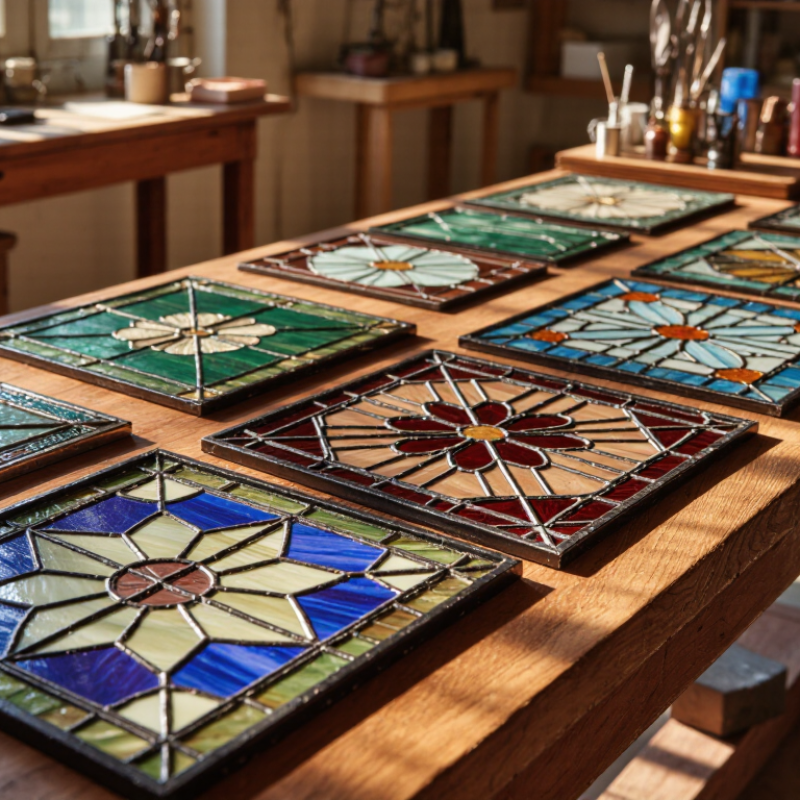
What Defines an Antique Stained Glass Panel Supplier in China
A qualified antique stained glass panel supplier offers more than attractive colors and decorative patterns. In practice, reliable suppliers explain whether each panel is genuinely antique, carefully restored, or newly made in an antique style. This distinction protects buyers from unclear descriptions. They should provide photographs of glass textures, solder lines, frame joints, and visible age marks. Small differences matter.
Professional suppliers understand traditional glassmaking and conservation methods. They can discuss hand-cut edges, lead came construction, surface oxidation, and safe cleaning limits. Some also work with skilled restorers who preserve original sections instead of replacing everything. Ask for condition reports, dimensions, weight, and close-up images. These details help architects and collectors plan installation safely. Experience shows that old panels may contain uneven surfaces, fragile joints, or previous repairs.
Documentation also defines a dependable supplier. Clear invoices, packing records, material details, and export paperwork support responsible trade. Strong suppliers use rigid crates, protective layers, and moisture control during shipping. Still, no supplier gets every detail right. A photograph may hide a repaired corner. A color sample may change under different light. That honesty matters. Buyers should request independent inspection when value or historical claims seem uncertain. The best working relationship allows questions, admits limitations, and records each decision before production or delivery.
This editorial benchmark uses a 100-point evaluation model rather than company-specific or brand-specific data. The highest weights are assigned to documented provenance, conservation-quality craftsmanship, and accurate reproduction of antique glass characteristics, followed by customization, material transparency, and export capability.
Selecting China’s top antique stained glass panel suppliers requires more than comparing catalog photos. The evaluation begins with verified experience in antique restoration and architectural glass production. A reliable supplier should explain whether each panel is original, reclaimed, or newly reproduced. Clear records matter, including material history, restoration notes, and ownership documentation.
Inspectors review sample panels under natural and warm light. They check glass texture, color variation, solder joints, frame stability, and visible repairs. Small bubbles may support an antique appearance, but weak joints create future risks. Suppliers should provide accurate dimensions, packing details, lead times, and defect policies. Safety documentation is also important when coatings, pigments, or old materials may require careful handling.
Professional knowledge comes from conservation methods, not decorative language. Evaluators may request workshop videos, test samples, and references from completed architectural projects. Transparent communication carries serious weight. Delayed replies or vague answers often signal poor project control. Independent quality checks can strengthen confidence, although they add time and cost.
No scoring system is perfect. A beautiful sample may hide inconsistent production. One supplier may excel in craftsmanship but struggle with export packaging. Another may document everything yet offer limited design flexibility. The final selection balances authenticity, workmanship, technical support, ethical sourcing, and dependable service.
| No. | Evaluation Dimension | Weight | Evidence Required | Scoring Method | Reason for Inclusion |
|---|---|---|---|---|---|
| 1 | Antique Style and Design Capability | 15% | Product catalogues, historical-pattern references, color charts, lead came or copper-foil options, and photographs of completed panels. | 0–5 points for documented historical styles, hand-finishing capability, pattern accuracy, and consistency between approved samples and production. | Antique stained glass requires decorative accuracy, period-appropriate color, texture, and construction details. |
| 2 | Glass and Material Specifications | 12% | Glass thickness, sheet size, texture, opalescence, color composition, solder type, came profile, backing system, and material declarations. | 0–5 points for complete technical specifications, stable material sourcing, and traceable batch information. | Clear specifications reduce color variation, dimensional errors, and substitution risk. |
| 3 | Workmanship and Structural Quality | 15% | Pre-shipment inspection records, joint and solder photographs, flatness checks, edge finishing, reinforcement details, and sample approval records. | 0–5 points for clean joints, uniform soldering, accurate dimensions, stable reinforcement, and low defect rates. | Panel durability and appearance depend heavily on assembly precision and reinforcement quality. |
| 4 | Safety and Applicable Glazing Standards | 12% | Test reports or declarations applicable to the project, including EN 12150-1 for thermally toughened glass, EN 14449 for laminated glass, EN 1279 for insulating glass units, or ASTM C1048 where relevant. | 0–5 points for relevant, current, and independently verifiable compliance evidence. Standards are applied only when appropriate to the specified panel construction. | Decorative panels used in doors, windows, partitions, or insulating units may require project-specific safety performance. |
| 5 | Customization and Engineering Support | 10% | CAD or vector drawing capability, shop drawings, color matching, structural dimensions, installation details, and sample revision records. | 0–5 points for drawing accuracy, revision control, prototype quality, and ability to support non-standard shapes. | Restoration and architectural projects usually require exact dimensions and custom patterns. |
| 6 | Quality Management and Traceability | 10% | Quality manual, inspection checkpoints, corrective-action records, batch coding, packing inspection, and ISO 9001:2015 certification when available. | 0–5 points for documented processes, measurable inspection records, and traceability from raw material to shipment. | Documented quality control makes supplier performance more repeatable and auditable. |
| 7 | Production Capacity and Lead Time | 8% | Monthly production information, sample lead time, standard order lead time, peak-season capacity, production schedule, and documented on-time delivery history. | 0–5 points based on transparent capacity information, realistic schedules, and evidence of delivery reliability. | Stained glass is labor-intensive, so capacity and scheduling directly affect project risk. |
| 8 | Export Packaging and Logistics | 6% | Export carton specifications, impact protection, moisture control, pallet design, shipping marks, insurance options, and damage-claim procedures. | 0–5 points for protective packaging, clear logistics documents, and a defined process for transit damage. | Glass panels are fragile and require packaging designed for international transport. |
| 9 | Environmental and Workplace Practices | 6% | Waste-handling procedures, solder and chemical controls, worker-protection measures, and ISO 14001:2015 or ISO 45001:2018 certification when available. | 0–5 points for documented environmental controls, occupational-safety procedures, and credible third-party evidence. | Glass cutting, soldering, chemicals, and metal waste require responsible workplace controls. |
| 10 | Communication, Service, and After-Sales Support | 6% | Quotation clarity, response records, sample approval workflow, warranty terms, replacement policy, spare-piece availability, and issue-resolution records. | 0–5 points for response quality, technical communication, contractual clarity, and documented after-sales procedures. | Reliable communication is essential when designs, colors, dimensions, and installation conditions change. |
| Total Evaluation Weight | 100% | The final Top 10 list should be published only after current supplier evidence, samples, and project-specific compliance documents have been verified. | |||
Scoring note: Each dimension is scored from 0 to 5, multiplied by its stated weight, and combined into a weighted total. EN 12150-1, EN 14449, EN 1279, ASTM C1048, ISO 9001:2015, ISO 14001:2015, and ISO 45001:2018 should be treated as applicable references rather than automatic requirements for every decorative stained glass panel.
China’s top 10 antique stained glass panel suppliers reflect different production strengths. These profiles consider craftsmanship, material control, customization, export experience, and after-sales communication. The ranking is not absolute. Project requirements can change the order.
Supplier 1 focuses on hand-painted panels with fine floral details and restrained colors. Supplier 2 is known for restoring damaged lead came and matching aged textures. Supplier 3 produces geometric panels for hotels, villas, and heritage-style interiors. Supplier 4 combines traditional copper foil work with carefully sealed edges. Its sampling process is practical, though revisions may take time. Supplier 5 offers custom panels from architectural drawings and small paper sketches. Clients should confirm scale before production. Supplier 6 specializes in warm amber, smoky blue, and irregular antique glass. These tones can appear darker indoors.
Supplier 7 provides reinforced panels for doors and room dividers, with attention to weight distribution. Supplier 8 supports larger commercial orders and uses documented inspection steps. Supplier 9 emphasizes historical visual research, but its reproduction work may require longer approvals. Supplier 10 serves bespoke residential projects, including curved frames and textured inserts. Ask for glass thickness, frame material, packing photographs, and installation guidance. A reliable supplier should explain color variation honestly. Antique-style glass is rarely identical between batches. That is part of its character, but it can also create design surprises. Experienced buyers request physical samples before accepting the final quotation.
China Top 10 Antique Stained Glass Panel Suppliers
When comparing China’s leading antique stained glass panel suppliers, design range is only the starting point. Some workshops recreate Victorian roses, Gothic borders, or Art Deco geometry. Others develop quieter patterns with aged amber, smoky blue, and uneven ruby glass. Ask whether each panel is an original antique, a faithful reproduction, or a newly assembled design. That distinction matters. Reliable suppliers should provide clear photographs, dimensions, glass samples, and production records.
Materials create visible differences. Handblown glass often shows small bubbles, ripples, and gentle color shifts. Machine-made glass usually looks more uniform. Traditional lead came gives strong linear structure, while copper foil supports finer curves and smaller decorative pieces. Ask about lead profiles, solder quality, protective coatings, and frame materials. Details matter. A well-made panel should have stable joints, clean edges, and no sharp exposed metal.
Craftsmanship is easier to judge through close-up images than polished showroom photos. Look for consistent solder lines, accurate pattern alignment, and firm glazing. Experienced suppliers should explain how they handle patina, repairs, packing, and installation support. Services also differ. Some provide custom sizing, technical drawings, sample approval, and reinforced export crating. Others offer only a finished panel. My practical concern is authenticity: an artificially distressed surface can look convincing online but feel flat in daylight. Request an unsanded corner or short workshop video. Ask for proof. Suppliers who answer precisely usually inspire more confidence, although even careful inspections cannot replace seeing the glass in person.
Comparing antique stained glass suppliers requires more than viewing attractive photographs. Request physical samples with visible solder lines, glass texture, frame joints, and color consistency. Samples reveal flaws. Check whether the supplier uses copper foil, lead came, or another construction method. Ask for material details and relevant test reports for your market. A reliable workshop should explain its inspection process, not simply promise premium quality.
Customization can include panel dimensions, glass opacity, border patterns, hanging hardware, and protective frames. Send a measured drawing with millimeter-level dimensions. Confirm the design through a digital proof and a pre-production sample. Pricing should separate glass, labor, framing, packaging, tooling, and shipping. Price is not quality. A low quotation may exclude export packaging or revision costs. Compare identical specifications across the shortlisted ten suppliers. This makes the comparison fairer, although small specification differences can still distort the result.
Export support often determines whether a beautiful panel arrives safely. Ask about reinforced crates, moisture protection, corner guards, and drop-test procedures. Request clear carton markings, commercial invoices, packing lists, and origin documents when required. Experienced suppliers should state production times realistically and explain how damaged goods are handled. Video inspections can provide useful evidence, but they cannot replace an independent inspection for large orders. My own comparison would also record response speed and drawing accuracy. These details seem minor, yet they often expose communication problems before payment and production begin.