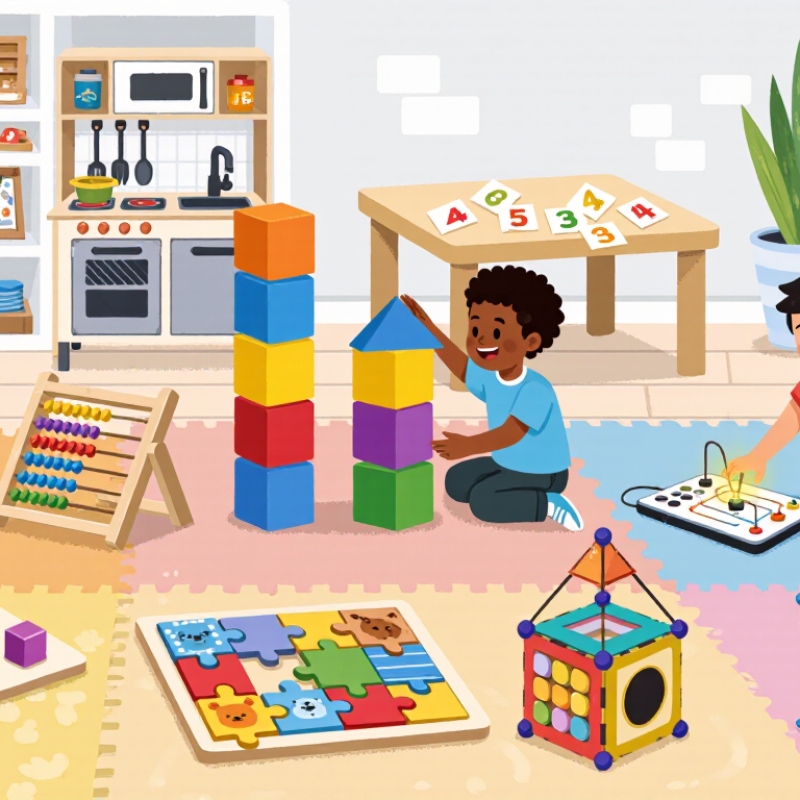
10 Best Learning Toys for Kids to Buy in 2026?

Choosing among the many Learning Toys available in 2026 can feel harder than it should. Bright packaging may promise big results, but a toy’s real value often appears during ordinary play: a child sorting wooden shapes, building a wobbly tower, or asking why a simple circuit lights up. The best choices invite curiosity and let children try, make mistakes, and try again.

This guide highlights ten options across different ages, interests, and budgets. It considers how each toy may support skills such as early counting, language, problem-solving, creativity, or hand coordination. It also looks at practical details parents can check, including age guidance, small parts, durability, cleanup, and whether children can use the toy in more than one way. Small details matter. A puzzle that is too difficult may frustrate; one that is too easy may soon be ignored.

No toy is magic. A well-designed activity can encourage learning, but it cannot replace conversation, rest, outdoor play, or an attentive adult. Children also differ: one may spend an hour building a pretend city, while another prefers a short game and then moves on. That is useful information, not a failure. The selections ahead aim to make comparison clearer, while leaving room for family needs, a child’s changing interests, and the occasional toy that looks perfect online but simply does not click at home.

10 Best Learning Toys for Kids to Buy in 2026?

How Learning Toys Support Children’s Development

How Learning Toys Support Children’s Development

Learning toys support development when children can touch, test, and change things. The American Academy of Pediatrics’ 2018 clinical report links play with language, executive function, and social-emotional growth. A child stacking blocks practices balance, planning, and persistence. A pretend shop invites counting, conversation, and turn-taking. These skills grow through repeated play, not just from owning a clever toy. Simple can be powerful.

Evidence also suggests that a crowded play space is not always better. In a small 2018 study in Infant Behavior and Development, researchers observed 36 toddlers aged 18 to 30 months. Children given four toys played longer and used them in more varied ways than children given 16. The finding is useful, but limited: it does not prove that fewer toys suit every child or home. Watch what holds a child’s attention. Does a puzzle invite another try, or cause quick frustration? A good learning toy should offer a manageable challenge, room for choice, and space for an adult to join without taking over. Some days, the cardboard box wins.

How to Evaluate Learning Toys for Different Ages

Age labels are a starting point, not a verdict on ability. For toddlers, look for large, washable pieces and simple cause-and-effect, such as a chunky peg dropping into a cup. Preschoolers may enjoy sorting, pretend play, and puzzles with several possible solutions. School-age children can take on kits that invite planning, testing, and revision. Watch the hands. If a child only copies one demonstrated move, the challenge may be too narrow—or the instructions may need simplifying.

Evidence favors interaction over flashy features. A 2022 systematic review and meta-analysis in Child Development examined 39 studies of guided play. Compared with direct instruction, guided play showed modest advantages in early mathematics (Hedges’ g = 0.24) and shape knowledge (g = 0.63). These findings support playful exploration, not the claim that every “educational” label improves learning. Adult questions can help; constant correction can also drain the fun.

Check fit, too. The U.S. Consumer Product Safety Commission’s 2023 toy-related injury report estimated 231,700 toy-related injuries treated in emergency departments among children aged 14 and younger. Follow age-grade warnings, check for loose or broken pieces, and consider whether a child can use the toy without frustration. A slightly imperfect choice may still work well when an adult joins in and adjusts the challenge.

Learning Toy Categories and the Skills They Build

Learning toys are not all alike. Puzzles invite children to rotate pieces, notice shapes, and practice spatial reasoning. Building blocks add planning and early engineering: a leaning tower can prompt a new design. It may fall first. That is part of the experiment.

Sorting games and simple counting materials support early math through comparison, grouping, and one-to-one counting. Art supplies encourage creativity and hand control, while pretend-play sets give children chances to practice language, storytelling, and taking turns. Simple science activities can build curiosity and observation, especially when children predict what might happen and describe what they see. These skills develop at different rates, so a toy’s age label is a useful guide, not a promise of readiness.

Tips: Choose toys that match a child’s interests and offer a small challenge without requiring constant adult help. Check pieces for age suitability and supervise play when needed. Ask open questions, such as “What could make it stand?” A toy can remain untouched, too; children’s interests change, and no single toy teaches everything.

Ten Learning Toys to Consider Buying in 2026

UNICEF’s Early Moments Matter guidance reports that about 90% of brain development happens before age five. This is a reason to offer varied play, not to rush into buying more. Ten learning toys to consider in 2026 include wooden blocks, shape sorters, chunky puzzles, and pretend-play sets. Blocks invite towers, bridges, and inevitable collapses. That is part of the lesson.

Other options are washable art supplies, counting beads, simple science kits, child-sized musical instruments, cooperative board games, and outdoor exploration kits with a magnifier. The American Academy of Pediatrics’ 2018 clinical report connects play with language, self-regulation, and social development. These toys can encourage those skills, but no toy guarantees a particular outcome. A puzzle may teach persistence; a board game can make turn-taking tangible.

Choose pieces suited to a child’s age and abilities, with clear instructions and manageable parts. Watch how the child actually plays. A quiet child may prefer sorting beads over group games. More is not always better. It is easy to overestimate how long a new toy will hold attention; familiar materials often inspire fresh play when adults join in without taking over.

Safety, Durability, and Value Factors to Check Before Buying

For a 2026 learning toy, safety matters more than a long list of features. Match the age label to the child, and inspect small pieces, cords, and battery compartments. The U.S. Consumer Product Safety Commission’s 2023 toy-related injury report estimated 231,700 emergency-room-treated injuries among children aged 14 and younger. This broad figure covers many kinds of toys, but it is a useful reminder to check hazards carefully. Look for clear safety information and sturdy construction. A loose wheel or cracked edge can change a toy’s usefulness quickly.

Tips: Tug gently at seams and attached pieces. Open and close hinges several times. Check that battery covers stay secured, and keep instructions for cleaning and care.

Durability affects value, too. Choose materials that can handle repeated drops on a playroom floor, and pieces that are easy to wipe clean. For puzzles and building sets, count the parts before buying and check whether replacements are available. Compare the likely years of use with the price, not just the number of activities advertised. A simple toy used often may offer better value than a complicated one left untouched. Still, no checklist predicts every break. Read recent safety notices, and reassess toys as children grow.

10 Best Learning Toys for Kids to Buy in 2026? — Safety, Durability, and Value Factors to Check Before Buying
Learning Toy Type Typical Age Range Skills It Can Support Safety Checks Before Buying Durability Factors Value Outlook
Large building blocks About 1–5 years; follow the package age guidance Spatial reasoning, creativity, early problem-solving, and hand-eye coordination For children under 3, choose pieces too large to swallow and avoid sets containing small accessories. Check for smooth edges and secure, non-flaking finishes. Look for sturdy pieces that connect reliably and can be washed according to the care instructions. Often offers strong long-term value because pieces can be reused for many kinds of open-ended play.
Simple shape and knob puzzles About 1–4 years, depending on piece size and complexity Shape recognition, visual matching, persistence, and fine motor skills Check that pieces are appropriately sized for the child and have no splinters, sharp edges, or loose parts. Avoid small pieces for children under 3. Thick pieces and a sturdy board are easier for young children to handle repeatedly. Usually a good entry-level option; choose a difficulty level the child can grow into without making the puzzle frustrating.
Counting and sorting manipulatives About 3–7 years; small pieces require close supervision Counting, sorting, pattern recognition, early number concepts, and fine motor control Many sets contain small pieces and are not suitable for children under 3. Store pieces securely and supervise children who still mouth objects. Durable, washable pieces and a lidded storage container help reduce loss and keep the set usable. Can provide good value when the same pieces support counting, sorting, pattern-making, and imaginative play.
Interlocking construction sets Commonly 4 years and up; check the specific set’s age label Planning, engineering concepts, spatial reasoning, and following instructions Check for small parts and age warnings. Keep pieces away from young children who may swallow them. Look for pieces that connect securely without excessive force and instructions that can be stored or accessed again. Value improves when parts can be combined with other compatible pieces or used for free building after the model is complete.
Magnetic construction tiles Often 3 years and up, but always follow the product’s age label Geometry, symmetry, spatial reasoning, and creative design Magnets can cause serious internal injuries if swallowed. Inspect tiles regularly for cracks, loose magnets, or damaged seams; keep damaged pieces away from children. Choose tiles with securely enclosed magnets and smooth, sealed edges; replace any tile that cracks or opens. Can be versatile for repeated building, but value depends on safe construction, piece count, and how often the child uses them.
Pretend-play kitchen or tool set About 2–6 years; select pieces suited to the child’s age Language, social interaction, role-play, and everyday problem-solving Check for small accessories, sharp edges, pinch points, and cords or straps that could pose a hazard. Avoid small parts for children under 3. Sturdy, easy-to-clean materials and replaceable or widely usable accessories can extend play life. Often offers good play value when children can use household-safe props or create their own imaginative scenarios.
Beginner science and nature kit Usually 5 years and up, with adult help as directed Observation, asking questions, simple measurement, and early scientific reasoning Read all age and supervision guidance. Check materials and experiment instructions; keep chemicals, small parts, and tools away from younger children. Prefer reusable tools and clear instructions; check whether any consumable materials need replenishing. Value is strongest when experiments use reusable equipment and everyday materials rather than a single-use activity.
Washable art materials About 2 years and up, depending on the material and package label Creativity, color recognition, hand control, and visual expression Use materials labeled for the child’s age and intended use. Follow warnings, supervise young children, and do not assume “washable” means edible or non-toxic. Durable, easy-to-clean tools and refillable supplies can reduce waste; store materials as directed to prevent drying out. Can be an economical choice when supplies are replenishable and the child can use them for many projects.
Beginner musical instruments About 2–7 years; instrument size and supervision needs vary Listening, rhythm, coordination, sound exploration, and turn-taking Check for loose parts, splinters, sharp edges, and detachable mouthpieces. Choose a suitable sound level and supervise instruments with small components. Solid construction, secure joints, and materials that can be cleaned as directed help instruments withstand frequent use. Simple instruments can offer lasting value through open-ended play and group activities.
Cooperative and matching board games Often 3 years and up; confirm the age label and small-piece warnings Memory, turn-taking, matching, counting, communication, and following rules Check the size of cards, counters, and tokens; keep small pieces away from children under 3. Supervise younger players as needed. Thick cards, sturdy boards, and a complete, easy-to-store set are more likely to last through repeated play. Can provide strong shared-play value, especially when the rules can be adjusted for different skill levels.

Buying note: Age ranges are general guidance, not a substitute for the package label or adult supervision. Toy safety requirements vary by market; check applicable compliance information, such as ASTM F963 and CPSIA requirements in the United States or EN 71 requirements in the European Union. Inspect toys regularly for damage, and stop using any item with broken parts, exposed magnets, or other hazards.

About Us

Andy’s Glass & Window Company of Temecula Valley has been servicing the glass, window and door needs of Southern California since the 1970′s. Operating from a 10,700sf commercial building in Murrieta, California, a neighboring town of Temecula.

Contractor’s License #821172

Andy’s Glass & Window Company

25751 Jefferson Ave, Murrieta, CA 92562

(951) 677-7421

sale@johnsonwindowtint.com

Store Hours:
Monday - Thursday 8:00 am - 5:00 pm
Friday 8:00 am - 4:30 pm
Closed Saturday & Sunday

Visit Us

Contact Information
Andy's Glass & Window Company